
The Key to Handling Your Child’s Big Emotions: Learn to Feel Your Own
When my PDA son was housebound and in burnout, I couldn't feel the grief and powerlessness of watching him suffer, so I numbed out with anger, chips and TV. This post explores where our patterns of avoiding emotions come from, why if you don't feel, you don't heal, and gentle steps to build tolerance for your own big emotions.
You can also listen to this in audio format only on The Regulated Parent Podcast on Apple or Spotify. Look for Episode #9
Below is the podcast turned into a blog article for easy reading.
The Key to Handling Your Child’s Big Emotions: Learn to Feel Your Own

It was three months into my son being housebound for the first time. He would not leave the house at all—not even to go into the backyard to get some fresh air and sunlight. No matter how hard we tried to get him interested and motivated to go out and do something he usually loved, he just couldn’t do it.
One day he said to me, “Mommy, I miss going for drives… I want to go…” and I saw a slight glimmer in his eyes of motivation, like a child dreaming of something just out of reach. But I also saw that glimmer fade almost instantly, replaced by a look of deep sadness. “I want to go, but I can’t…” and that was all he could say.
At the time, I was learning more about Pathological Demand Avoidance (PDA), and how the PDA brain, when overwhelmed, can shut down even in the face of something the child genuinely wants. Even pleasure can feel like pressure. My son was in burnout. His anxiety, OCD, and PDA all collided, making it harder and harder for him to engage in the things he once loved.
The Cost of Watching Your Child Suffer
As a mother, watching your child unable to do what they love is a heartbreaking experience. I would feel the tightening in my chest, the drop in my gut—only to quickly go numb. The emotions were too much and my system would automatically shut them down. I could feel the stress in my body, and my mind registered feeling bad for him, and guilty I couldn’t do more. But the grief, the deep heartbreak, the powerlessness was not available to me at that moment.
I told him, “I know your brain won’t let you go out right now, but one day it will again.” This was what I learned growing up: reframe pain into hope. It felt like the right thing to do. But in truth, I was using the old, fail-safe strategy of “don’t worry, it’ll get better” so I didn’t have to sit with the scarier feelings of extreme fear, grief and powerlessness of not knowing when this would get better.

The Patterns That Protect Us from Feeling
After that moment, I went about my day, helping my son meet his basic needs, all while suppressing the emotional waves that had been stirred in me so I could function. But by the evening, I started to feel it. I was cooking, cleaning up—and suddenly I felt this agitation and anger creeping in. I found myself getting irritated at the objects around me: the spatula that sprayed food, the dish that slipped from my hand. That low-grade irritation at everything around me was a nervous system pattern I knew very well.
That night, once my son was asleep, I laid on the couch to watch TV and felt a strong urge for salty, crunchy chips—even though I had already eaten a big meal. I needed them. So I grabbed the chips and ate them, tuning out and going into my own little world where it was just me, the chips, and the TV. It felt like bliss. A mini getaway. I’d done this before. At the time, I called it “stress eating.” I didn’t yet understand the truth behind this pattern.
The next morning, I would wake up with a heavy feeling—still carrying the weight of yesterday’s emotions that never got felt or moved through. That heaviness would morph into agitation, then into frustration, and eventually I’d find myself being short or angry with my son, unable to tolerate his fears, his anxiety, his anger.
It wasn’t until I began to understand the nervous system that I realized: these were protective patterns. They were strategies my nervous system had long ago adopted to keep me from feeling the deeper, more vulnerable emotions—like grief, shame, sadness, powerlessness, fear and terror. I had developed a pretty severe intolerance for those emotions.
It was this lack of being able to be with and feel my emotions and let them process and release from the body - this “intolerance” to emotions - that drove the behaviors to do anything to avoid them: get angry so I don’t have to feel the sadness, grief, guilt, shame, or powerlessness; zone out on chips and TV and stuff myself until I feel nauseous, just so I could feel something else instead of the pain of my heart breaking because I could not help my son.

Moving Towards An Inflexible Nervous System
Over time, as my son became less able to meet his basic needs or do much of anything, my automatic nervous system pattern to lock in all the emotions just increased, mounting more and more emotional load in my body, sending my nervous system into feeling increasing amounts of threat, and moving me more into the dorsal system of shutdown where I just felt exhausted all the time. I was carrying years and years of unprocessed emotions, and it was resulting in my nervous system becoming more and more inflexible. It was getting harder to handle the challenges: I was cycling more between sympathetic fight/flight with increasing amounts of anger and anxiety, and then dropping more into freeze with numbing out, shutting down, feeling quite exhausted and having a hard time getting out of bed. I was startling more easily, snapping more at my husband, and my system was looking to numb out and dissociate every chance it got. I didn’t feel like seeing friends anymore, and I didn’t know how to get back to feeling truly relaxed and rested either.
Other signs started to show up, like chronic tension, headaches, digestive upset, fatigue, feelings of burnout like I couldn’t handle anymore, feeling wired but tired. I was also losing my ability to feel beneficial emotions like happiness, gratitude and hope and instead feeling more depressed - because that’s what happens when you numb out the nonbeneficial emotions, you also end up numbing out the more beneficial ones too.

If You Don’t Feel, You Don’t Heal
This intolerance to feel and process the more vulnerable emotions like sadness, grief, shame and even fear and terror in the face of your child facing so many intense challenges, is a real challenge for many. But the bigger challenge is this: if you don’t feel, you don’t heal. The nervous system gets stuck and becomes more inflexible and it becomes harder to handle the challenges. The nervous system loses its resilience because it starts to believe that there is nothing you can do but stay stuck with all these emotions.
The reality is that to be a regulated parent and human, we need a flexible nervous system that can be in flow and ride the waves of the activation and release that energy as well as ride the waves of the lows of the vulnerable emotions and release that energy from the body. When we are able to do this, the nervous system stays flexible and more resilient to take on challenges. But my nervous system was going in the opposite direction, following the old deep-seated patterns of shutting down the emotions, and as a result showing more and more signs of inflexibility.
Where These Patterns Come From
Where did these protective patterns to block feeling emotions and vulnerability come from?
Early Developmental Experiences
One of the ways we learn to be with vulnerable emotions and know how to let them process and release from the body actually comes from our first experiences in life with our caregivers. If they could handle our big emotions, with attunement, love, care, patience - not anxiety, fear, anger, ignoring or dissociating - then our nervous system learned that we can be ok in the face of these big emotions. But this was not the case for many of us.
The patterns of learning to soothe with food can start very early on, when we cried as babies, and instead of tuning into what we really needed, a parent or caregiver gave us milk or food, even if we just ate. We may have learned “this is how I soothe my emotions - I feed them”. Or perhaps there was the experience of being left alone to cry it out, which could lead to the feeling that “no one will attend to my emotions so I need to shut them down because it’s too hard to be with them on my own”. Or being told “don’t cry, you’re ok” can lead to confusion resulting in believing that “my emotions are not valid and don’t matter, so I will shut them down” or “I’m bad for having emotions”. Or even receiving anger from your parents when you had big emotions can result in taking on the belief “I am not loved and I lose connection with my caregiver if I have big emotions” which can result in locking down or not even feeling the emotions through life.
It is important to note that it is not just vulnerable emotions like sadness and grief, fear and terror that can get bypassed and locked down. If we had parents, caregivers (or even teachers) that did not tolerate anger at all, or made you feel bad for expressing anger, then as an adult tolerating your own anger can feel challenging, resulting in a constant freeze response automatically shutting it down, leading to chronic tension, tight jaw issues, chronic somatic symptoms or even burnout later in life.

Trauma or overwhelming stress
When we face overwhelming experiences—especially in the absence of safety, support, or co-regulation—our nervous systems often shut down, fragment, or go into survival mode to protect us. In these moments, the full intensity of the emotion can’t be processed, so it gets stored or "stuck" in the body as unfinished business. Over time, this can erode our trust in our ability to feel emotions safely. Instead of experiencing emotions as something we can move through, our systems begin to perceive them as threats to avoid, leading to patterns of numbing, dissociation, or chronic dysregulation.
Family, Generational Trauma
Other ways we learned to shut down emotions is from generational patterns passed down from the family system we were born into and observed by us when we were young and learning how to be in life. These generational patterns can be seen as the “burdens” of the family system that were inherited due to trauma never being processed and released. Patterns of bypassing and shutting down emotions that we may have observed in our parents and family members could be things we heard or saw in the face of vulnerable emotions like: a parent saying “oh just think of the positive” or “yah but what about this positive thing about this situation?”, or using laughter, humour and jokes to bypass vulnerable emotions, or even watching our parents walk around in an angry huff much of the time because they could not deal with their own vulnerable emotions. As kids we watch these patterns and we absorb them like a sponge and take them on as our own, without even consciously choosing them ourselves.

Cultural Conditioning
And what about the culture we live in? The one that shows anger more than vulnerability, but then also says anger is bad and you’re bad if you show anger - especially if you’re a woman. Or the culture that consumes and consumes - media, social media, shopping, food, alcohol, drugs. There is so much unconscious messaging and opportunity out there to escape feeling the vulnerable feelings and keep our minds busy so we can escape the pain.
In addition, most cultures reinforce the belief that emotions should be controlled or hidden — especially in public or professional settings. And we're often taught to “get over it,” “be strong,” or “stay positive”, rather than listen to and stay with what we feel. We have all probably felt the deep messaging that being emotional is weakness, and strength is about hiding your emotions.
Many cultures also thrive on doing and keeping busy all the time. Why? Part of this is to avoid being present and feeling the vulnerable emotions by doing the things that make us feel productive and more worthy. Because once that mind starts to turn off and you become more still and present, that’s when the emotions start to come to the surface, screaming at you “please please feel me and heal me!”. But if you didn’t have anyone mirror to you how to be with such intense emotions with love, care and presence, and to allow them time to process and leave, then you just learned what the rest of us did - to shut it down and move on with the pattern that helps you the most in that moment to not feel.
Lack of Interoceptive Awareness
Many of us grow up without any training or support in how to feel and track sensations in our bodies—the very foundation of emotional experience. This lack of interoceptive awareness means we often move through life disconnected from the signals that tell us what we’re feeling and what we need. Without this embodied awareness, the body doesn’t know how to process or contain the intensity of emotion that arises, leaving us more vulnerable to overwhelm, shutdown, or reactive patterns when emotions become too much.
This was me. The emotion would creep up, I would unconsciously feel it, and before I even knew it was there, my mind was shutting it down and moving onto the chosen avoidance pattern - low grade anger, agitation, blaming things outside of me, scrolling endlessly, eating without awareness, getting busy and hyperfocused on doing and getting stuff done. But all of these patterns just mounted more stress load and filled up my already full emotional bucket, thus leaving my nervous system ready to explode or collapse at all times.
Building Tolerance For Our Own Emotions Helps Our Parenting
To be a more regulated parent, who can handle the challenges with greater ease, the nervous system needs to be able to ride the waves of the emotions and feel them, process them and let them leave the body. The nervous system then returns back to homeostasis and balance again, ready to take on the next challenge. This is a flexible nervous system. To be able to hold our own activation in the face of our child’s behaviors means to have tolerance for all the emotions getting triggered inside of us without going to the extremes of locking them down only for them to pile up without you even knowing it, or for them to finally explode, and you feel blindsided by them and have no idea why you reacted so extremely.
The reality is our children have extreme emotions and if we want to teach them true regulation and how to feel safe in the face of their own activation and emotions, then we need to feel safe with ours first. The nervous system learns most easily by observing the other nervous system - no words needed. When you can show up as “I’m ok with what’s getting triggered inside and I know how to contain it”, then this shows up to your child as “my mom can handle this and feel safe with it, so I can learn to feel safe with this big emotion too.”

The truth is our kids can feel very scared of their own emotions as this is a natural part of how our brain works when emotions are so intense and you have a hypersensitive brain that feels them so intensely. In the midst of my son’s huge rages, I would see the fear in his face for the hole he had just put in the wall. He was scared of his own intense emotions. And he felt so much shame for them in the aftermath. But I couldn’t hold space for these intense emotions, until I was able to tolerate holding space for my own.
Building tolerance and capacity for emotions and allowing space for them to process and release is no easy task for a nervous system wired to avoid painful emotions because it learned unconsciously that this was the only way to do it. You need to first become conscious of the protective avoidance patterns your system automatically engages in to escape feeling vulnerable emotions.
What Avoidance Patterns Can Look Like
Behavioral patterns of blocking, shutting down or avoiding emotions can look like the following:
- You have a hard time crying or feel embarrassed when you do cry.
- When you try to go inside and feel your body sensations your thoughts take over or you become distracted.
- You don’t love sad songs or movies. You prefer to stick to lighter, happier movies and music.
- When someone talks about their feelings you quickly point out the positive side of things.
- When emotions begin to bubble up inside, it quickly turns to anger or you dissociate or numb out on food, alcohol, tv, social media or work.
- When your kids cry you tell them “oh you’re fine”.
- You stay busy a lot and feel uncomfortable being still and present.
- When you cry or lash out and it feels so big, you wonder where did this come from? Why is this so big?
- You intellectualize a lot.
- You experience chronic anxiety, depression, dissociation or somatic symptoms
Body based patterns of bracing against emotions can feel like the following:
Our bodies show these same avoidance patterns in physical ways too. The body may contract, tighten and brace against emotions in the neck and shoulders (to cut off the mind from feeling the body), or a tightening of the chest to brace against fear or grief, or clamping down on the jaw to hold in the anger, or the tightening of the gut or lower back too. These are ways our body shows us it’s bracing and trying to lock down the emotions because they feel like too much.
These are some of the protective avoidance patterns you may notice. I invite you to start to observe the ways in which your nervous system automatically bypasses or shuts down vulnerable emotions.
There is no shame if your system goes into these defense patterns. It is a natural part of being human, and also a pattern that was necessary for much of your life if you didn’t have anyone to help you with your big emotions.
Why The Brain Defends Against Emotions
Defending against vulnerable emotions is also part of how the human system is naturally designed - to put up defenses when needed to get through the wounding experiences, but also to let them down once there is safety and connection.
I always wondered why the brain is designed to defend against vulnerable emotions? Why aren’t we designed to tolerate these emotions?
It’s partly because emotions are registered and felt in the same areas of the brain as physical pain – so emotions can actually feel like we are truly in pain. This defense mechanism is there for good reason. It is designed to help us get through situations where we may not have another safe other to help us process the emotions when the environment is too wounding, so we must stay in defended mode.
For example, if you’re at school and made fun of, and you don’t have parents or a teacher who can help you through it, then you hold in all the feelings and get through your day. This makes sense. Or if you were abused or attacked, your brain will shut down the emotional and physical pain by going into freeze and shutdown. But the design was meant to be a temporary experience and not to stay stuck this way for long. Once we are with a safe other or in a safe environment, we are designed to let the defenses come down and release the emotions. This helps our nervous system to release the stress and come back to baseline. But what if the environment we live in is too wounding? Then we never really have the opportunity for the defenses to come down, and we believe, at the nervous system level, that the only option is to keep them up. This leads to a chronic feeling that emotions are dangerous.
The Hypersensitive Brain and Nervous System
The other thing to note is we could have also been born with a very sensitive nervous system and sensory system, which would create an environment inside of us that feels threatening and overwhelming due to the way our brain processes sensory stimuli (including emotions), rendering us even more unable to tolerate emotions and stay stuck in defense. This is the case for many of our kids and those of us who are Neurodivergent or highly sensitive parents too.

The reality is if you have a hypersensitive nervous system and brain, or if your child is currently going through many months of intensity that challenge your nervous system to the extreme and you spend most of your day with them, then you may not have the time, space, or permission to let all the guards down and feel all the feels. You may still need these defense patterns much of the time, and that is ok too. In this situation, you can even find some learning, growth and healing to just notice the protective patterns when they arrive, and thank them for trying to protect you. There is a lot of healing that comes just from awareness, allowing and accepting that this is the way it needs to be right now, but that doesn’t mean it needs to be this way forever.
Moving Towards Greater Emotional Capacity And Nervous System Flexibility
For those of you who can get some space, or there are times when things are relatively more stable in your environment, then can you acknowledge that although these patterns were needed before, can you explore if they are truly needed now? Is it causing more harm than good for your nervous system and your ability to be a regulated parent for your child now?
Building tolerance for emotions and having capacity to feel those emotions fully is what makes the difference between a dysregulated and regulated parent.
Without emotional capacity, we tend to react impulsively from survival states instead of responding from our calm and clarity. We may shut down or disconnect from ourselves and others, feel ruled by our triggers, and struggle to co-regulate with our children or partners. But as we build capacity, we become more able to stay open and present with hard emotions, rather than being overwhelmed by them. This allows us to begin healing stored trauma, cultivating deeper attunement in our relationships, and developing the kind of inner resilience and peace that makes it possible to parent—and live—with greater compassion and clarity.
Reclaiming Emotion: The Invitation
For a long time, the only place I could truly cry and let out my pain and grief was in the car. I would put on a sad song and let it touch my heart and then the tears would come. Growing up, home was not a safe space for me to let out my emotions, and ironically (but not really, as this is how the perfect design of life unfolds) I had that exact situation at home now, with a child who felt so threatened by my emotions and a husband who was maxed out and could not hold space for my intense emotions. So the car was my safe haven for releasing my emotions for a period of a few years. Now I like to go on long walks in nature and allow my emotions to flow as I do my inner healing work. Nature is all about flow and this energy supports my nervous system from staying stuck and helps it to move back into that flow.
And you can find your pockets of space to have little bits of healing too so that your nervous system has a chance to heal, bit by bit, and be more ready to handle the next challenge with greater ease.
- The first step to healing emotional avoidance patterns is recognizing the pattern itself when it shows up.
Allow this pattern to be here. Get curious about it, becoming the watcher of this pattern, with no judgment, just curiosity, without trying to change it. That awareness alone can help you to feel some space from the pattern itself - to be with it instead of taken over by it. Then you can see that you are not this pattern - it is a survival pattern trying to protect you.
Then ask inside to this pattern: “What are you trying to protect me from feeling?”
The answer you will get is the emotion that it is trying to avoid. This will help you to gain insight without having to change anything for now.
2. When the emotion is present, the next step is to notice where you feel this emotion in the body. Can you notice the sensations of this emotion and see if you can tolerate being with it for a few moments.
The key here is to slow down and give yourself time and space to become present with this emotion, even if for just a few seconds or minutes.
But the other key is to make sure you don’t force yourself to stay with a painful emotion if it feels like too much. You do not want to dissociate as that is counter to healing. Allow yourself to touch into it, feel it, and then take breaks from it by coming out of the feeling and orienting to the space around you and noticing something that brings you comfort. This is the safe way to teach your body and brain that you can tolerate intense emotions. Not by pushing through and staying with it, but by touching into it, and then coming out of it and touching into something more neutral or comforting. This gentle back-and-forth—called ‘pendulating’—teaches the body that feeling big emotions can be safe and it builds capacity for the body to tolerate these intense emotions.
3. If you can tolerate being with the emotions, then you can also bring an experience of safety and care to this emotion.
Most of our emotions are trapped, incomplete emotions from past traumas. Can you bring a new experience of safety and care to this emotion that never got this when you were young. Perhaps a gentle soothing caress to your face or arms, or a soft hand on the heart, or a whisper inside to this emotion…”I see you, I hear you, I’m here for you.”
Start small - you could set a timer, or put on a sad song and let yourself feel and cry, and when the sad song is over, you can move on and let that protective pattern take over again. But do this with awareness and being the watcher instead of fully taken over by the emotion.
 4. Building capacity - The ongoing work is to slowly build tolerance for these intense emotions. Each time you allow an emotion in, can you stay with the pain of it for a little bit longer? Can you tolerate being with it, but with the help of care and compassion?
Many intense emotions we feel today when triggered by our children are actually from past traumas where no one was there to support you through it and you felt all alone. The only choice you had back then as a child was to go into Dorsal shutdown and lock it all away. But now, as an adult, can you show up for these emotions with more gentleness, care and compassion. Can you give that little child inside of you a new experience of safety in the face of these emotions? Because when you can do this, your nervous system learns it’s safe to feel…and “someone is here for me now”…and that someone is You. This felt sense of safety and care we can bring to our inner experience now changes the internal wiring in the nervous system and moves it towards greater safety and regulation in the face of vulnerable emotions.
Building Resilience For You and Your Child
When you can hold space and care for your own emotions, the journey of parenting a hypersensitive, high-needs child becomes less intense and more tolerable. And the space to feel the beneficial emotions—like happiness and joy for the little moments of true connection with your child—begins to emerge again, helping the nervous system to bounce back and become more resilient to handle the next challenge with greater ease.
Becoming a human who can handle all the intensities of life and the emotions that come along with them is about truly being able to allow all that is—and to be with all that is—in a way that tells your nervous system:
“Even though this is hard, I can be with this. And I can be okay.”
This is how we build resilience. This is how we become the regulated presence our children need.
It is when our True Self can show up for the hurting little one inside, that the healing begins—and a new experience of safety emerges in the face of challenging emotional experiences.
This is the greatest gift you can give your child: the ability to feel, to heal, and to grow—by learning to do that for yourself. And that gift doesn’t end with them. It lives on in them and ripples outward into future generations.
Questions Parents Ask
Why do I get angry or numb out instead of feeling sad about my child's struggles?
These are protective patterns. They are strategies my nervous system had long ago adopted to keep me from feeling the deeper, more vulnerable emotions, like grief, shame, sadness, powerlessness and fear. Getting angry, zoning out on food or TV, or getting busy can all be ways to avoid feeling the pain. There is no shame if your system goes into these defense patterns.
How does feeling my own emotions help me handle my child's big emotions?
Our children have extreme emotions, and if we want to teach them how to feel safe in the face of their own activation, we need to feel safe with ours first. The nervous system learns most easily by observing the other nervous system, no words needed. When you can contain what's getting triggered inside, your child can learn to feel safe with big emotions too.
Where do patterns of shutting down emotions come from?
They can come from early experiences with caregivers who couldn't handle our big emotions, from trauma or overwhelming stress, from generational patterns in our family, from cultural conditioning that says being emotional is weakness, and from a lack of interoceptive awareness. We may also have been born with a very sensitive nervous system that makes emotions feel more threatening.
What are signs that I avoid my emotions as a parent?
You may have a hard time crying, prefer lighter movies and music, or quickly point out the positive when someone shares their feelings. Emotions may quickly turn to anger, or you may numb out on food, TV, social media or work. You might stay busy and feel uncomfortable being still. Your body may brace in the neck, shoulders, chest, jaw or gut.
How can I safely build tolerance for big emotions?
First, notice the avoidance pattern and ask it, "What are you trying to protect me from feeling?" Then notice where you feel the emotion in your body. Don't force yourself to stay with it if it feels like too much. Touch into it, then orient to something comforting. This gentle back-and-forth, called pendulating, teaches the body that feeling big emotions can be safe.
Why You Feel Depressed When Parenting a Hypersensitive, High-Needs Child
when numbing leads to shutdown and depression
Watching Your Autistic, PDA Child Suffer
the grief and helplessness of watching them struggle
Why You Can't Relax, and How to Teach Your Nervous System That It's Safe
teaching your body it is safe to rest
Understanding the Grief That Comes With Parenting a High Needs Child
naming the grief you may be avoiding
I have four free guides for parents of PDA, autistic and high-needs kids: the 3 Shifts guide for meltdowns, the 4 Shifts Hitting guide for when your child hits, the 7 Truths guide on why you react even when you know better, and the Meaning guide for finding your way back to yourself. Pick whichever one fits where you are right now.
Click Here to Get the Free Guides
And if a question comes up while you’re listening, or while you’re reading one of the guides, come ask it in The Regulated Parent Facebook group. It’s a free, private place to share, ask, and be with parents who truly get it.
And if you want to go deeper with me, the Regulation Rebuild is my course for parents who want to rebuild their own nervous system capacity, step by step. Join the waitlist to hear first when the next round opens.
About the author: Afshan Tafler is a Nervous System Resilience Coach, host of The Regulated Parent podcast, and a parent raising a PDA autistic teen with high anxiety and OCD. She is trained in Internal Family Systems (Level 3), Havening, polyvagal-informed practice and EFT, and is completing her Somatic Experiencing training. She has guided hundreds of parents of ADHD, autistic and PDA kids from burnout and barely coping to steadier, more connected and more alive, within the life they are actually living.
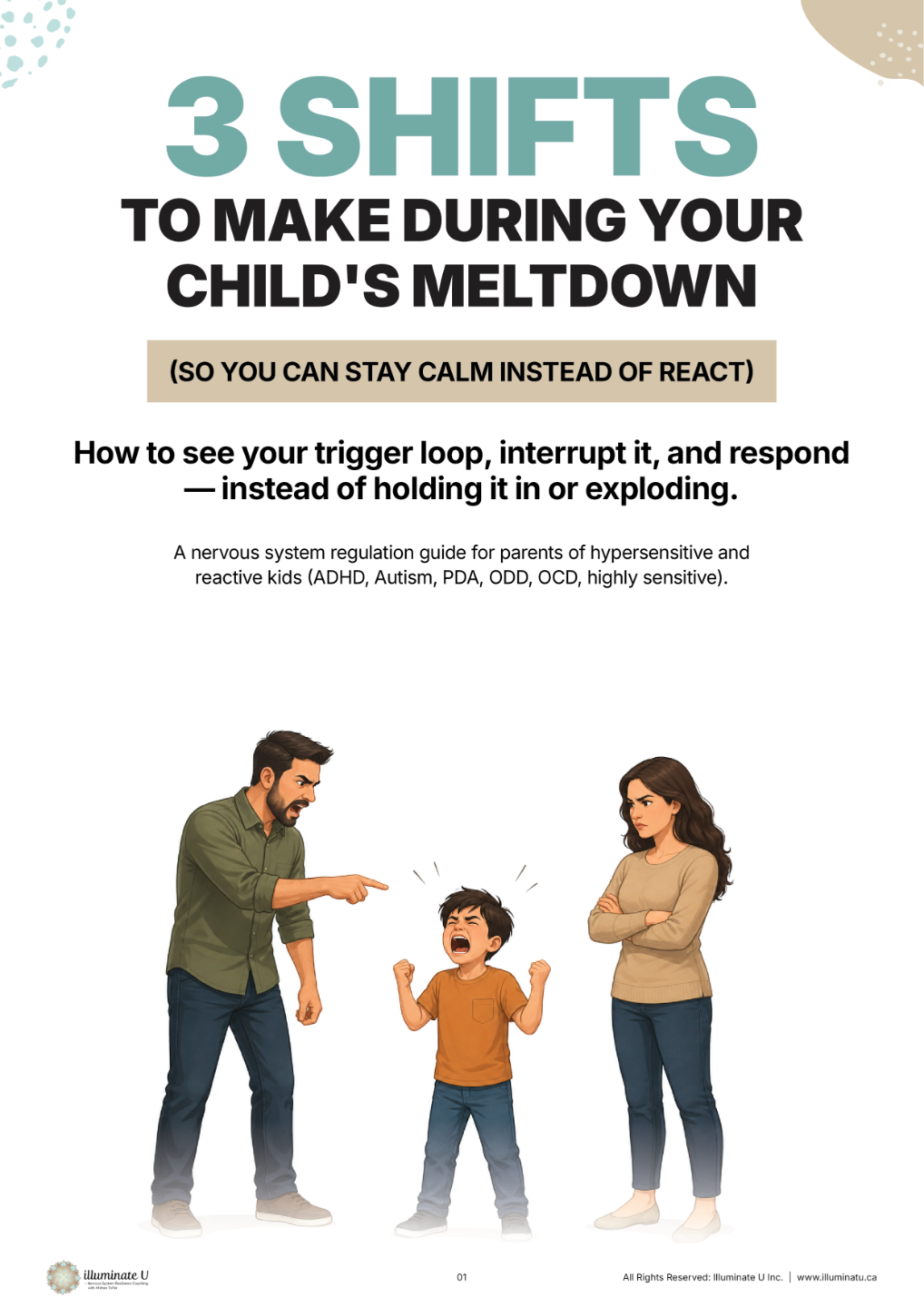
Free: The 3 Shifts Guide
The trigger loop and 3 patterns you get stuck in during meltdowns — and how to shift them so you can stay calm instead of react.
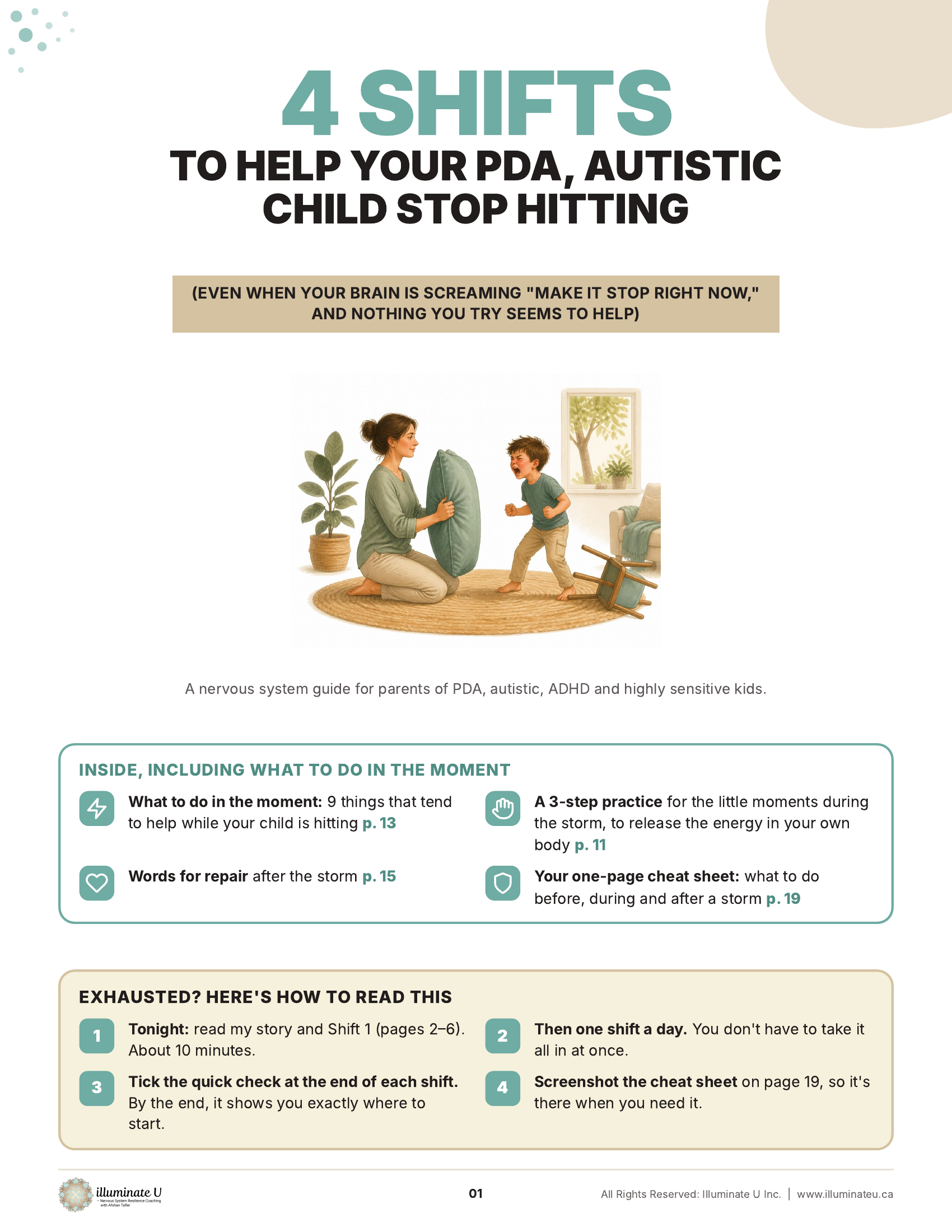
Free: 4 Shifts to Help Your PDA, Autistic Child Stop Hitting
What to do in the moment your child is hitting you, a one-page cheat sheet to keep on your phone, and the 4 shifts that changed things in our home.
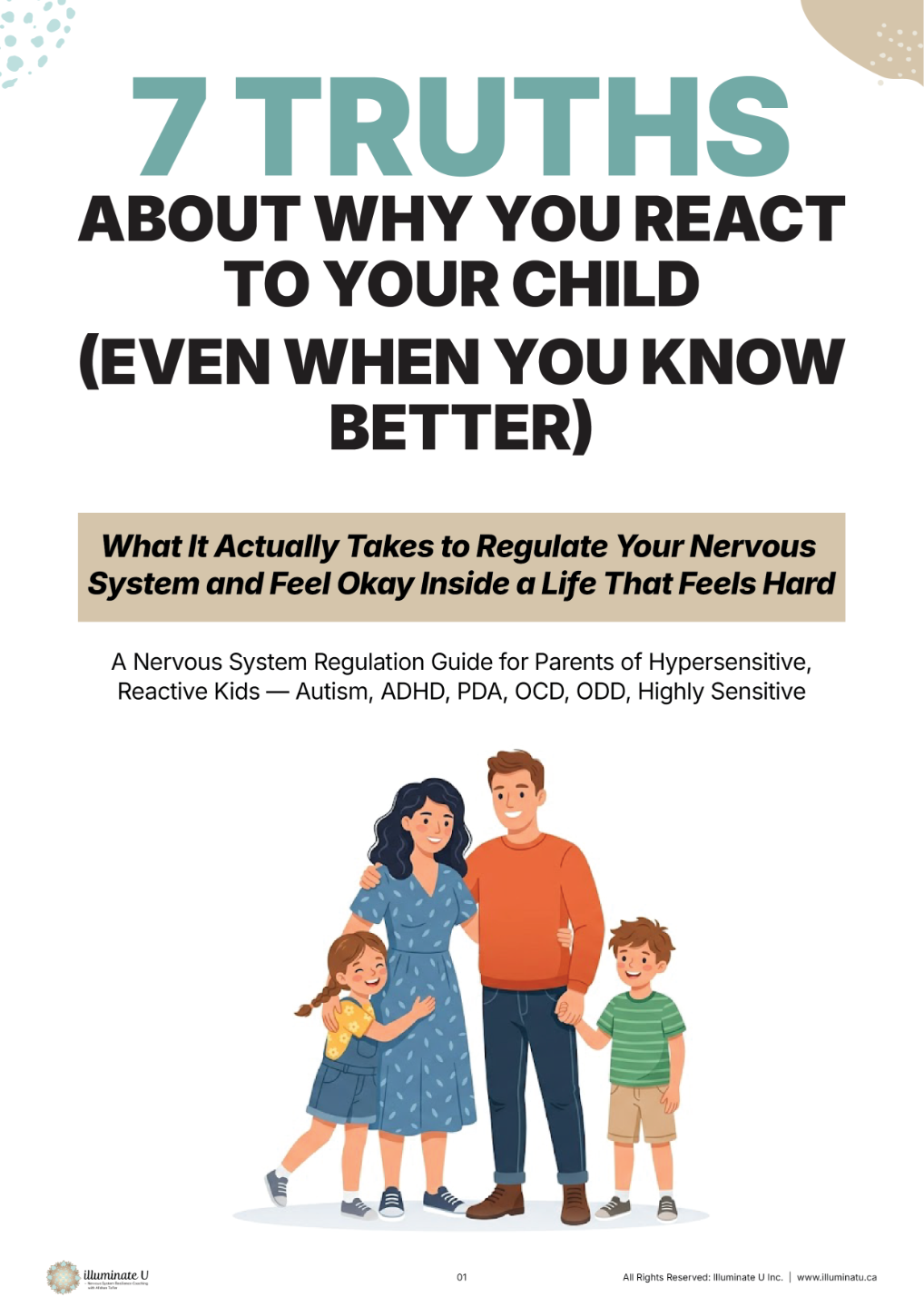
Free: 7 Truths About Why You React to Your Child Guide
Why you react even when you know better — the conditioning, nervous system states, hidden beliefs and patterns, and buried emotions running the show.
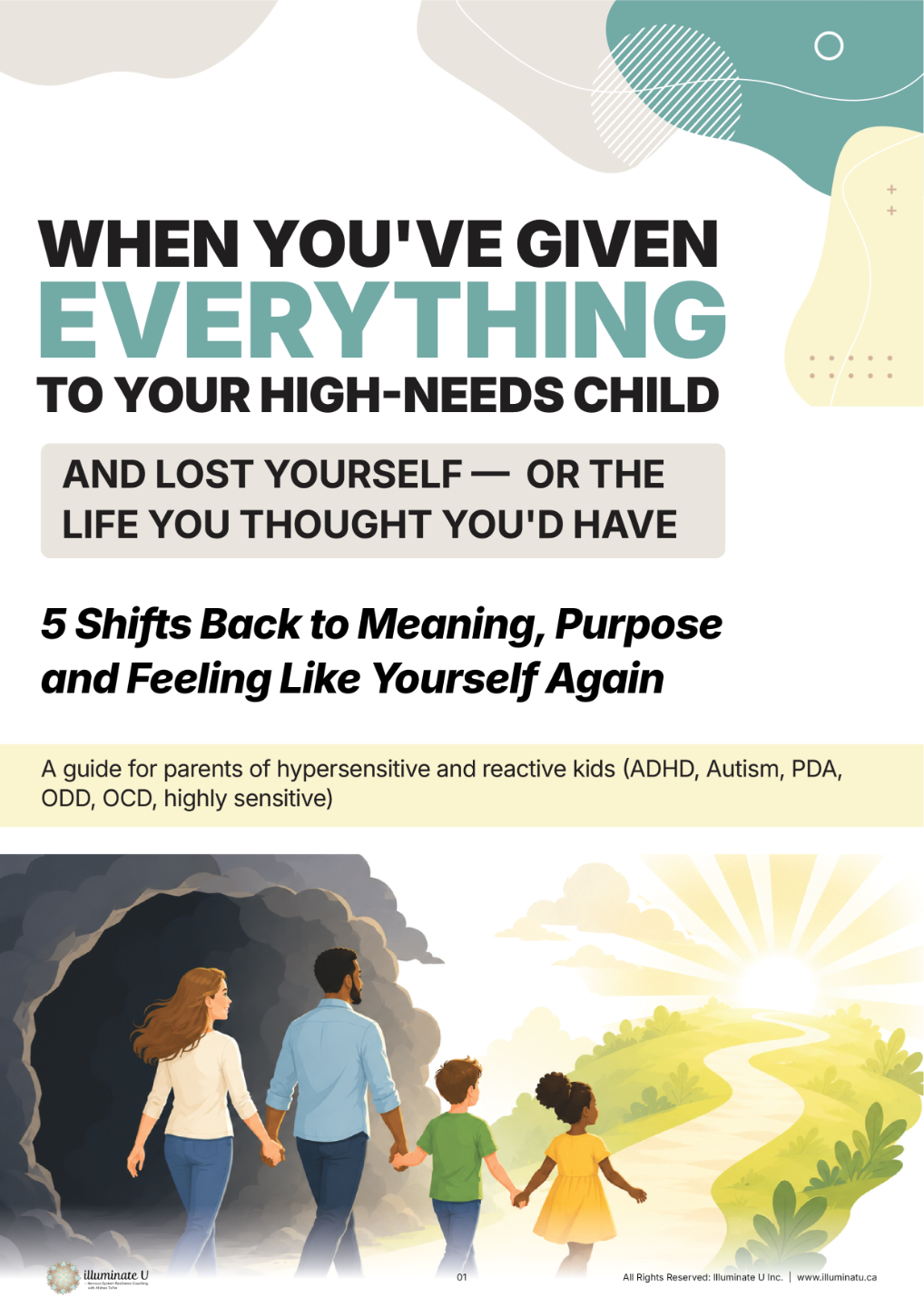
Free: 5 Shifts Back to Meaning Guide
For when you've given everything to your high-needs child and lost yourself — 5 shifts back to meaning, purpose and feeling like you again.
Free: The Regulated Parent Facebook Group
Ask your questions about the podcast and the free guides, and be with other parents who truly get it. Free and private.

