
Why Lowering Demands for Your PDA Child Can Make You Feel Like You’re Falling Apart

When I started lowering demands for my son, it helped his nervous system but activated every survival pattern inside my own. This post explains the polyvagal mismatch between a PDA child and parent, the beliefs and conditioning that make low-demand parenting feel unsafe, what really causes burnout, and how to rebuild safety without abandoning yourself.
You can also listen to this in audio format only on The Regulated Parent Podcast on Apple or Spotify. Look for Episode #23
How Lowering Demands Helped My Child and Unraveled Me
I didn’t learn about PDA (Pathological Demand Avoidance) during a single “aha moment.” It was more of a slow unraveling—someone mentioned it in passing, I tucked it away, and weeks later I finally sat down at my computer one night after another overwhelming day. My child had refused almost everything, melted down multiple times, shut down completely, and nothing I had tried made sense. Desperate for some kind of insight, I typed “Pathological Demand Avoidance” into Google. I didn’t expect answers, but as I read, something inside me went very still. Then softened. Then cracked open with recognition.
It wasn’t just that the information made sense—it was that my body recognized the truth. The fear underneath his refusals, the panic fueling the explosive “no,” the way the smallest request could feel like danger, the shutdowns that looked like defiance but were really collapse—it all suddenly had a name. And for the first time, I understood that what we were dealing with wasn’t behavior. It was a survival response trying to communicate to me that my son was not feeling safe enough to comply with life’s demands.
That realization led me toward reducing demands in small, hesitant steps. I loosened our routines, stopped pushing transitions, removed my son from school, and even removed any structured learning from the equation altogether. And while these changes helped my child feel more accepted, relieved and more safe to some degree, my own nervous system was struggling even more. If anything, the more I reduced demands on him, the more demands I increased on myself to meet his needs, and the more fear and pressure I felt inside myself.
My anxiety rose. My body tightened. I second-guessed everything. Each accommodation created more internal fear. What if I’m doing this wrong? What if he never learns? What if I’m enabling him? What if I ruin his future? What if people are judging me? What if I’m not doing enough? And alongside the fear, I found myself holding in my reactions more than ever—biting my tongue, controlling my tone, suppressing frustration, and trying to appear calm when I was anything but. On top of this, I felt I had to meet all of his needs at the expense of my own.
It was only later that I understood what was happening: lowering demands helped my child’s nervous system, but it activated every survival pattern inside my own. And the more I held in, the more I gave in and denied my needs, the more I carried, the more depleted and burnt out I became—not because I was doing too little or even doing too much – but because I was holding too much.
Lowering Demands Helps Your Child—But Dysregulates You
Reducing demands is essential for PDA children. It decreases perceived threat, increases autonomy, reduces meltdowns, and helps their nervous system shift toward safety. For them, fewer demands feel like relief and regulation.
But for you, the opposite often happens. When you let go of the tools you were raised with—structure, discipline, follow-through, consistency, doing more and “just do it”—your nervous system may interpret this shift as danger. You lose the familiar signals of safety you grew up depending on to make you feel worthy and enough, and without realizing it, you enter your own survival response. You might feel anxious, untethered, out of control, or like the ground beneath you has disappeared.
This is a polyvagal mismatch.
Your child’s nervous system says: “Less pressure means safety.”
Your nervous system says: “Less structure and less doing means danger.”
This mismatch creates an internal whiplash. Your child becomes calmer, while you become more activated (but hold it in). Their nervous system feels supported, while yours feels destabilized.
Understanding this mismatch is essential, because it explains why you might feel more overwhelmed—not less—when you begin lowering demands.
The Beliefs That Get Activated When You Lower Demands
Lowering demands doesn’t just change how you parent. It triggers a cascade of deeply ingrained beliefs stored in your body—beliefs tied to how you learned to be safe, loved, belonging and successful growing up. These beliefs often sound like:
- “I’m not doing enough.”
- “I’m being too soft. Good parents have more control over their child”
- “If I don’t push him, I’m failing him.”
- “Good parents have structure and expectations.”
- “He’ll never learn if I don’t teach or enforce things.”
- “People will judge me.”
- “I’m losing control of everything.”
These beliefs don’t live in your mind—they live in your nervous system. They were shaped through decades of conditioning, through family systems, schooling, cultural messages, and generational expectations about obedience, productivity, responsibility, and performance. When you lower demands for your child, these beliefs become activated in the body, sometimes intensely.
This is why lowering demands can feel like you are breaking the rules of what it means to be a “good parent,” or a “successful human” even when you know intellectually that you are supporting your child in the most attuned, trauma-informed way possible.
The Conditioning That Makes Low-Demand Parenting Feel Unsafe
Most of us grew up in systems where compliance equaled goodness, productivity equaled worth, being “easy” equaled love, and pushing through was considered strength. In those environments, meeting your own needs was often secondary—or not allowed at all. You may have learned to fawn, to perform, to please, to push, or to make yourself small to keep the peace or earn approval.
So when you begin reducing demands for your PDA child, you are not just changing a parenting strategy. You are challenging your entire conditioning.
Your body interprets low-demand parenting as:
- rebellion
- loss of control
- a threat to your identity
- breaking unspoken family or societal rules
- stepping outside of what kept you safe growing up
This tension doesn’t live in your thoughts—it lives in your fascia, your breath, your jaw, your shoulders, your posture. It is cellular. It is somatic. And it explains why your child’s relief can simultaneously feel like your panic.
The Invisible Weight of Holding In Your Reactions
The part that most parents aren’t prepared for is how much emotional and physiological suppression low-demand parenting requires. When you reduce demands, you also reduce the amount of frustration, urgency, and overwhelm you can outwardly express. You find yourself carefully managing your tone, your facial expressions, your language, and even your body movements.
You may find yourself trying to look calm while your insides are full of activation. You swallow your impulses to correct or push. You override your instinct to speed things up or insist. You absorb your child’s overwhelm without discharging your own. And this means your body is carrying far more survival energy than it ever gets to release.
Over time, this trapped activation builds up. It shows up as irritability, resentment, exhaustion, anxiety, muscle tension, headaches, shutdown, or emotional numbness. These aren’t signs of failure. They are signs of a nervous system holding too much without any way to complete the stress cycle and release the stress that gets trapped inside the body.
The Old Survival Patterns That Get Triggered
What I didn’t understand at first—and what so many moms I work with eventually realize—is that low-demand parenting doesn’t just activate anxiety. It awakens old childhood survival patterns like fawning, appeasing, people-pleasing, or staying small to keep the peace.
These patterns weren’t weaknesses. They were brilliant survival strategies your nervous system developed early on to stay safe in environments where your stability depended on other people’s emotions. Many of us learned as children:
“If they’re not okay, I’m not safe.”
So you became the one who soothed, softened, adjusted, and took responsibility for everyone’s emotional state. Not consciously—your body did this automatically.
When you begin lowering demands for your PDA child, these patterns often become more intense, not less. The more you work to reduce pressure for your child, the more you may silence your own needs, soften your boundaries, shape-shift to avoid triggering them, and take responsibility for their emotional world.
This happens because your child’s overwhelm activates old trauma physiology. Your nervous system reacts as if you’re back in those early environments where someone else’s distress meant danger.
And without realizing it, you start abandoning yourself—again.
This creates another layer of burnout:
you’re not only holding in survival energy,
you’re also losing connection to your own needs, identity, and inner world.
The Collision of Needs Between You and Your Child
Your child and your body often need opposite things at the same time. Your child needs autonomy, space, freedom, choice, and minimal pressure. But your nervous system may need structure, predictability, reassurance, clarity, and boundaries to feel safe.
This creates a painful internal conflict: “How do I meet their needs without abandoning mine?”
You’re trying to hold safety for your child while your own body is struggling to find safety itself. This conflict is not a mindset issue—it is the collision of two nervous systems with different survival strategies.
This mismatch creates chronic tension inside you, which becomes a major driver of burnout.
What Really Causes Burnout in PDA Parenting
Burnout in PDA parenting is not caused by doing too little. It comes from a double survival load:
- Holding in your survival reactions (fight, flight, freeze energy with no release)
- Increasing accommodations (more attunement, more flexibility, more emotional labor - more staying “ON” for your child)
- Meeting your child’s intense needs at the expense of your own
- Sustaining a constant internal conflict between old conditioning and new parenting demands
This is nervous system burnout, not just emotional exhaustion. It happens because your body is stuck in survival physiology—activated or collapsed—without enough moments to release activation or receive nourishment.
Parents need rest, but rest is often not available in long stretches. So the path forward is learning how to:
- release trapped survival energy
- take micro-moments of nourishment
- let the nervous system “turn off” briefly
- reconnect with your own needs
- rebuild internal structure that supports you without placing pressure on your child
When you don’t have these pressure valves, burnout becomes inevitable—not because you’re doing it wrong, but because your nervous system has been carrying more than any one person should ever have to hold.
Rebuilding Safety Without Abandoning Yourself
The solution isn’t to push your child or tighten demands. It’s to rebuild your internal safety so that lowering demands doesn’t feel like chaos inside your body. This means learning how to gently complete stress cycles, allowing movement, shaking, crying, orienting, or any safe discharge of survival energy.
And it also means repairing the deeper survival pattern underneath all of this — the one that learned in childhood that you had to stay small, pleasing, accommodating, or emotionally responsible for others in order to stay safe. These patterns weren’t your fault; they were brilliant strategies your nervous system created to protect you. But they can get reactivated in PDA parenting, leading you to abandon your own needs without even realizing it. Part of rebuilding safety now is gently teaching your body a new truth: you can be okay even when someone else isn’t.
It also means giving yourself small moments of support—not big, dramatic self-care, but tiny drops of nourishment throughout the day: a moment to breathe more slowly, unclenching your jaw, relaxing your shoulders, stepping outside for air, letting yourself pause without guilt.
Rebuilding safety is both a somatic and emotional process. It involves challenging old beliefs at the body level—not through mindset alone—and learning how to co-regulate in a way that doesn’t require self-abandonment. And it requires slowly increasing your capacity in ways that honor both you and your child.
A New Story of Parenting and Self-Compassion
Parenting a PDA child is not about perfection. It is about presence, attunement, and compassion—both for your child and for yourself. Your child isn’t refusing you; they are protecting themselves. And you aren’t falling apart because you’re doing it wrong. You’re unlearning decades of conditioning, holding emotional labor for two nervous systems, grieving the parenting story you thought you’d have, and rebuilding safety from the inside out.
Lowering demands didn’t break you. It awakened everything inside of you that has been waiting to be acknowledged, soothed, and healed.
If you feel overwhelmed, chaotic, or like you’re losing yourself, it doesn’t mean you’re failing. It means you’re doing profoundly hard, transformative work: breaking generational patterns and learning to create safety for both your child and yourself.
You are not failing.
You are healing.
You are evolving.
You are becoming the parent your child needs—and the parent you needed, too.
Questions Parents Ask
Why do I feel worse after lowering demands for my PDA child?
When you let go of the tools you were raised with, like structure, discipline, follow-through and consistency, your nervous system may interpret this shift as danger. This is a polyvagal mismatch. Your child's nervous system says: "Less pressure means safety." Your nervous system says: "Less structure and less doing means danger." Your child becomes calmer, while you become more activated.
Am I being too soft by lowering demands for my PDA child?
Beliefs like "I'm being too soft" or "If I don't push him, I'm failing him" don't live in your mind. They live in your nervous system, shaped through decades of conditioning about obedience, productivity and performance. This is why lowering demands can feel like breaking the rules of what it means to be a good parent, even when you know you are supporting your child in the most attuned way.
What causes burnout in PDA parenting?
Burnout in PDA parenting is not caused by doing too little. It comes from a double survival load: holding in your survival reactions with no release, increasing accommodations, meeting your child's intense needs at the expense of your own, and a constant internal conflict between old conditioning and new parenting demands. It's not because you're doing it wrong.
How do I lower demands for my PDA child without burning out?
The solution isn't to push your child or tighten demands. It's to rebuild your internal safety. This means gently completing stress cycles through movement, shaking, crying or orienting, and giving yourself tiny drops of nourishment throughout the day: a slower breath, unclenching your jaw, stepping outside for air, letting yourself pause without guilt.
Why a PDA Child's Need for Control Can Feel So Dysregulating for Parents
when accommodating leaves you feeling trapped
How to Accommodate Your PDA, Autistic Child Without Fear, Burnout, or Losing Yourself
accommodating without fear or self-abandonment
Why "Holding It Together" Is Burning You Out
why suppressing reactions leads to burnout
The Shame Spiral of "Not Doing Enough" For Your PDA, High-Needs Child
the fear that you're not doing enough
Why Staying Regulated With Your PDA Child Means Letting Go of "Shoulds"
loosening the shoulds that keep you activated
I have four free guides for parents of PDA, autistic and high-needs kids: the 3 Shifts guide for meltdowns, the 4 Shifts Hitting guide for when your child hits, the 7 Truths guide on why you react even when you know better, and the Meaning guide for finding your way back to yourself. Pick whichever one fits where you are right now.
Click Here to Get the Free Guides
And if a question comes up while you’re listening, or while you’re reading one of the guides, come ask it in The Regulated Parent Facebook group. It’s a free, private place to share, ask, and be with parents who truly get it.
And if you want to go deeper with me, the Regulation Rebuild is my course for parents who want to rebuild their own nervous system capacity, step by step. Join the waitlist to hear first when the next round opens.
About the author: Afshan Tafler is a Nervous System Resilience Coach, host of The Regulated Parent podcast, and a parent raising a PDA autistic teen with high anxiety and OCD. She is trained in Internal Family Systems (Level 3), Havening, polyvagal-informed practice and EFT, and is completing her Somatic Experiencing training. She has guided hundreds of parents of ADHD, autistic and PDA kids from burnout and barely coping to steadier, more connected and more alive, within the life they are actually living.
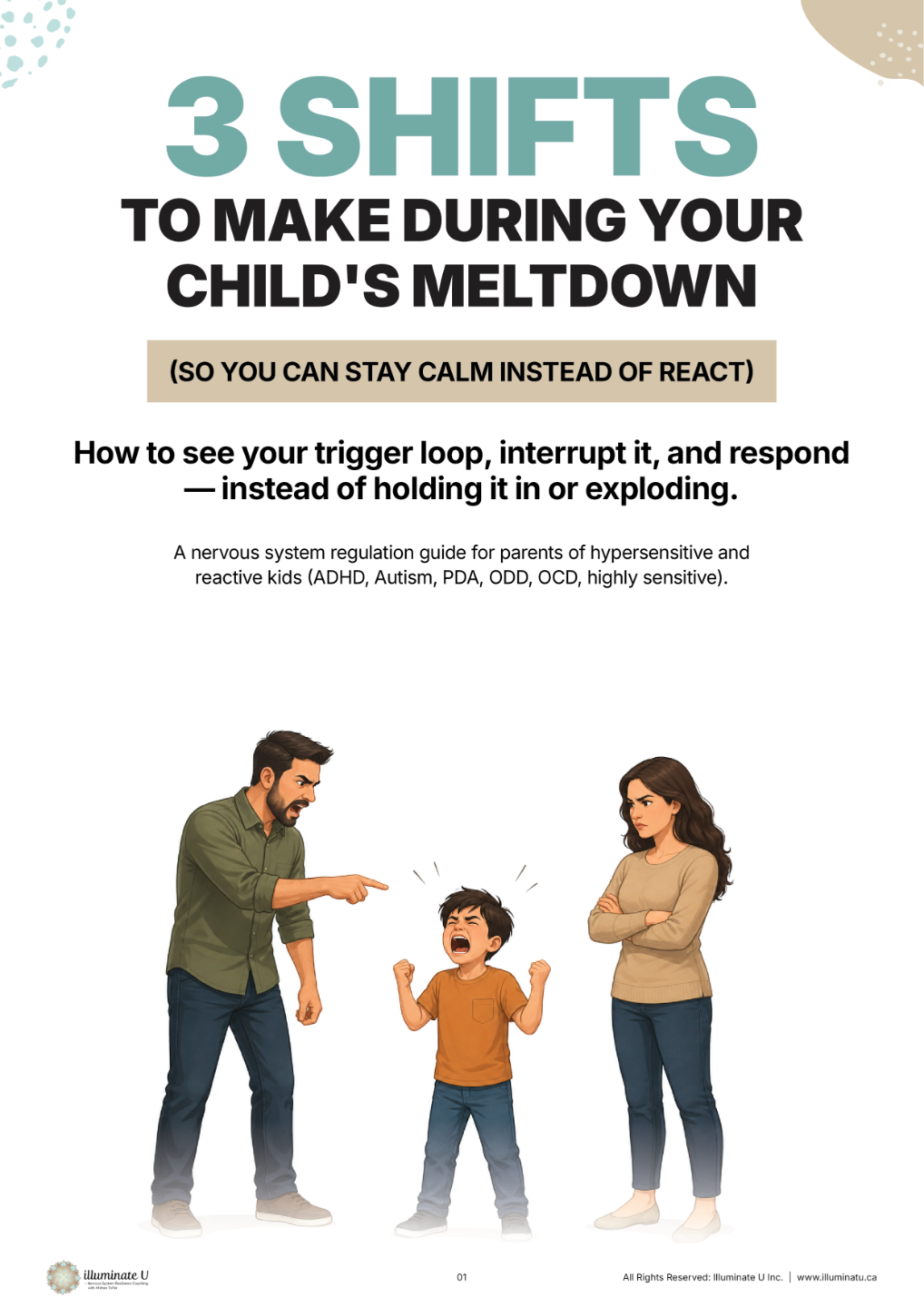
Free: The 3 Shifts Guide
The trigger loop and 3 patterns you get stuck in during meltdowns — and how to shift them so you can stay calm instead of react.
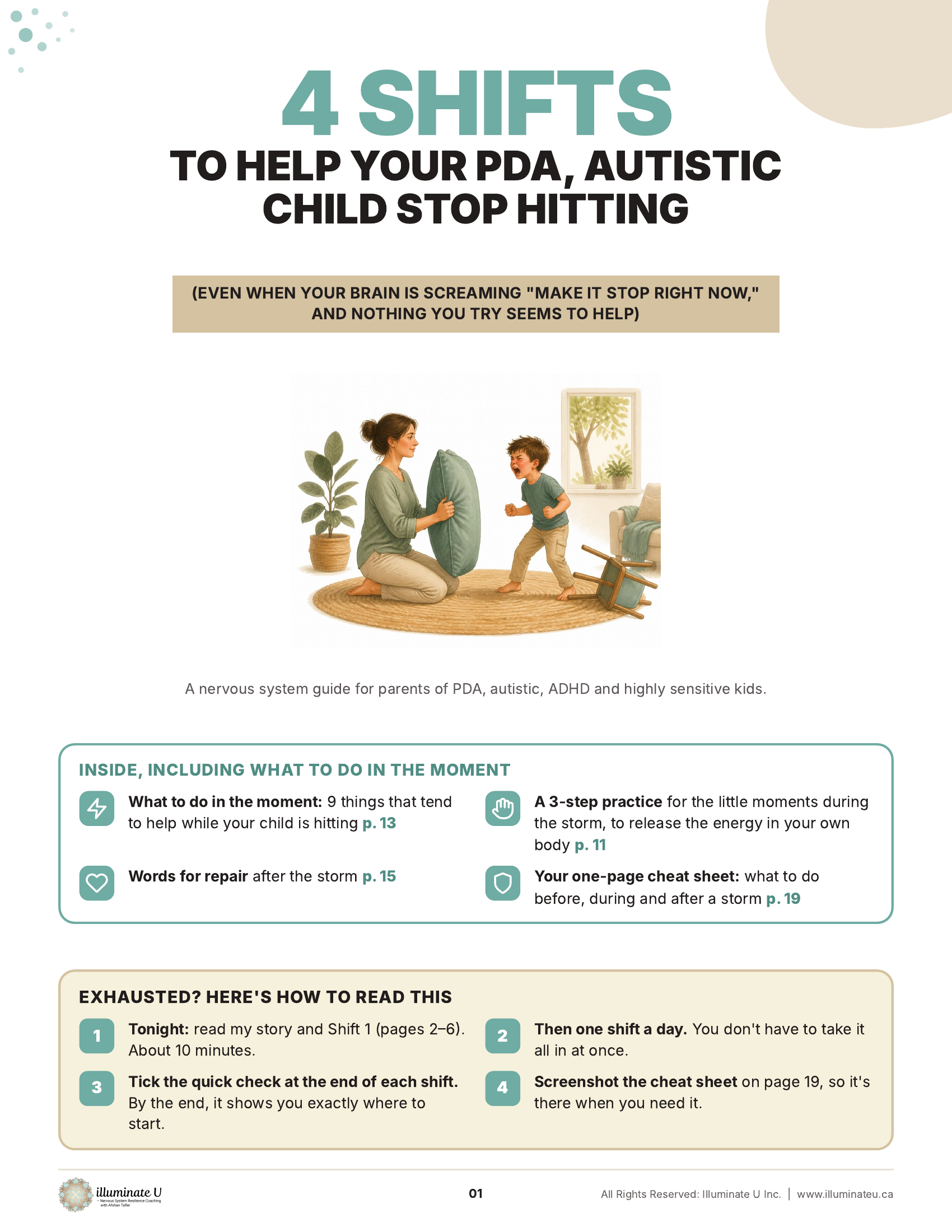
Free: 4 Shifts to Help Your PDA, Autistic Child Stop Hitting
What to do in the moment your child is hitting you, a one-page cheat sheet to keep on your phone, and the 4 shifts that changed things in our home.
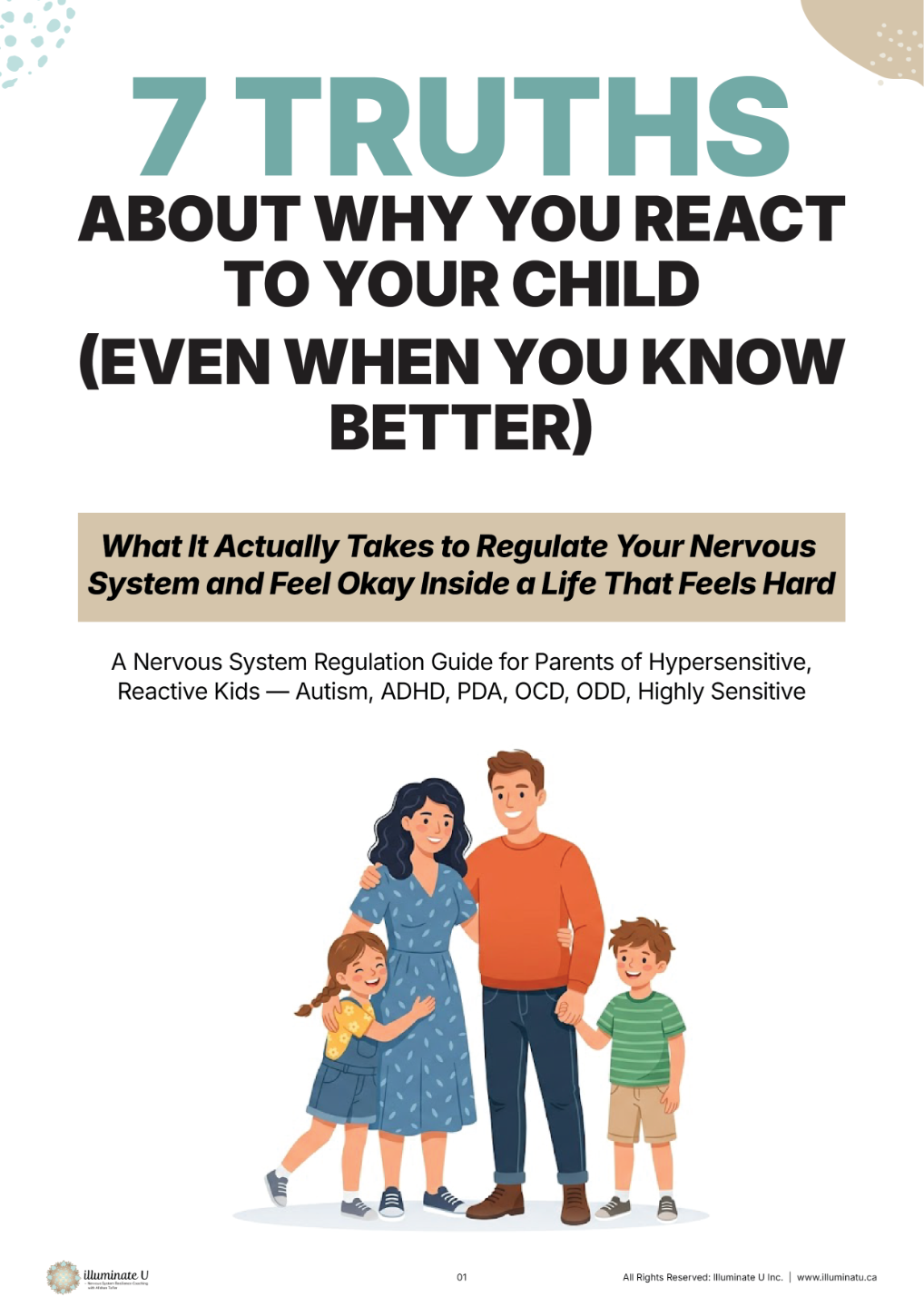
Free: 7 Truths About Why You React to Your Child Guide
Why you react even when you know better — the conditioning, nervous system states, hidden beliefs and patterns, and buried emotions running the show.
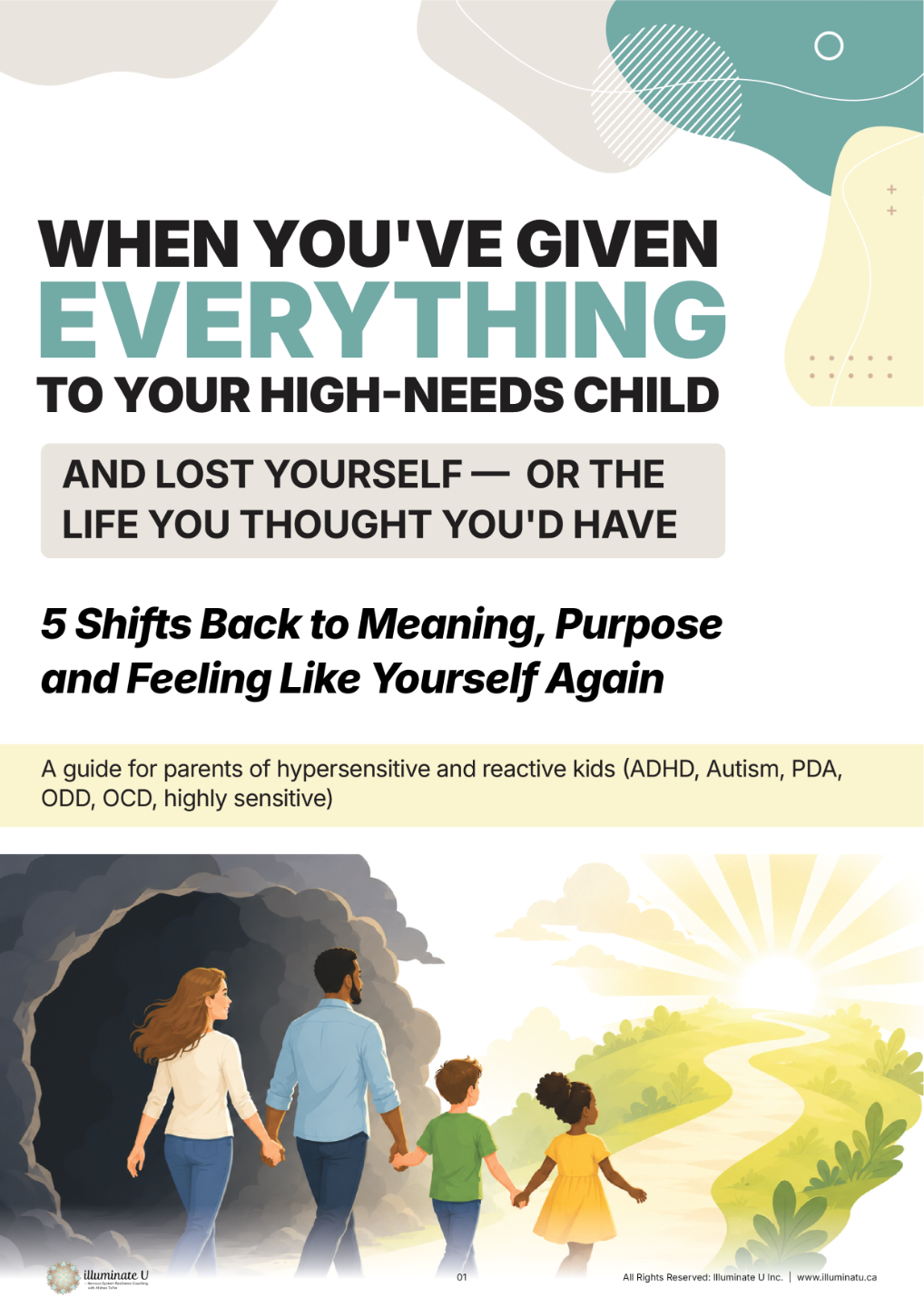
Free: 5 Shifts Back to Meaning Guide
For when you've given everything to your high-needs child and lost yourself — 5 shifts back to meaning, purpose and feeling like you again.

Free: The Regulated Parent Facebook Group
Ask your questions about the podcast and the free guides, and be with other parents who truly get it. Free and private.

